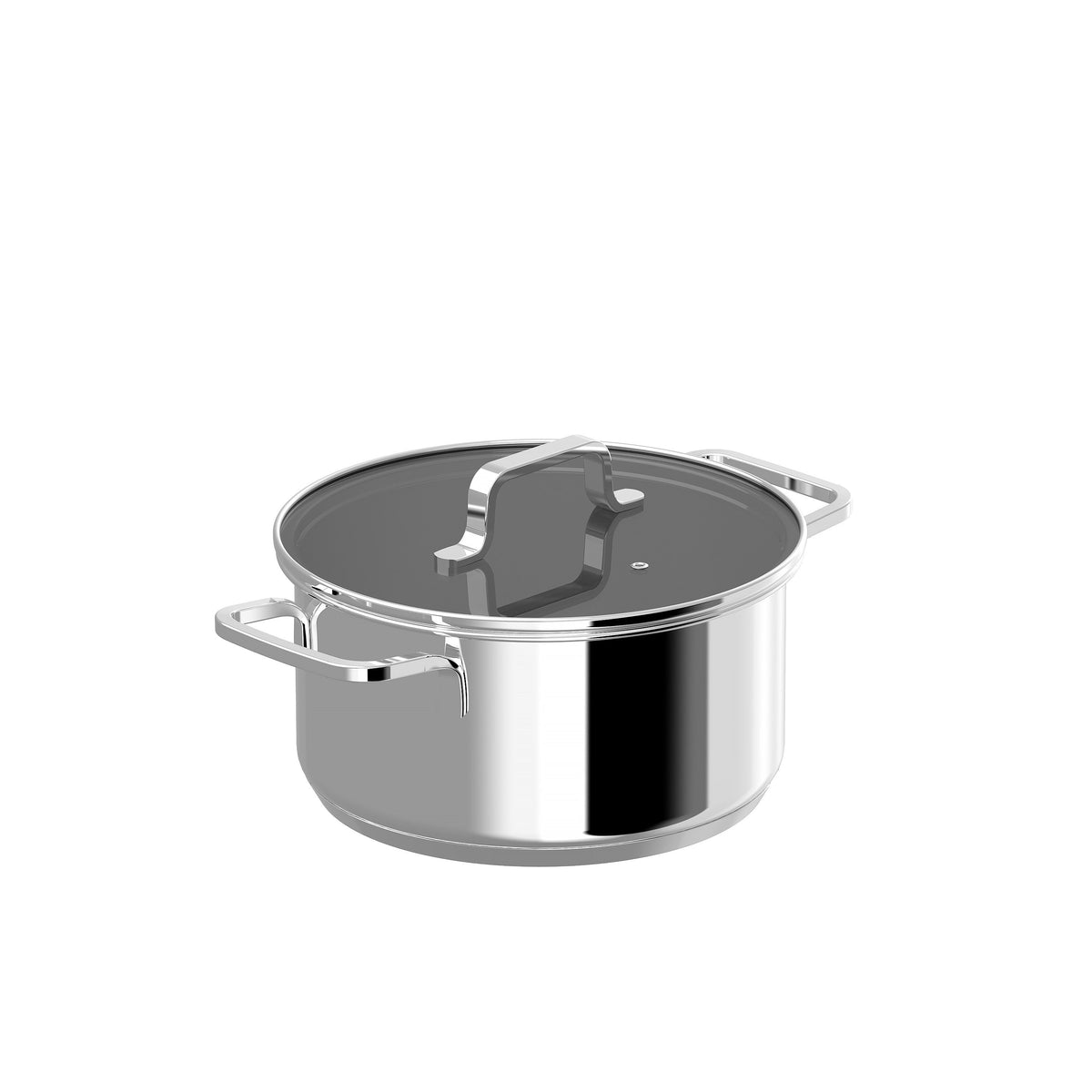
A saucepan is the small pot with one long handle, for sauces, porridge, eggs and reheating. A casserole is wider, medium-sized and has two side handles – the one for rice, potatoes, vegetables and smaller stews. A stockpot is the big, tall pot for soup, stock and pasta. A Dutch oven is a heavy lidded pot, classically enamelled cast iron, that goes from the hob into the oven for slow braising. Most kitchens use the first three every week; the Dutch oven is the one you add if you love slow cooking.
The names are confusing, not least because they mean different things in different English-speaking countries. Below we explain what sets each pot apart – shape, height, handles and capacity – and when to reach for which. If you are building a kitchen from scratch and want a shopping list with sizes, start with our cookware buying guide; here we go deeper into the differences.
The four pots at a glance
| Pot | Shape and handles | Typical size in our range | Best for |
|---|---|---|---|
| Saucepan | small, fairly deep, one long handle | 16–18 cm, about 1.5–2 L | sauces, porridge, boiled eggs, reheating, rice for two |
| Casserole | wider than it is tall, two side handles | 16–20 cm, about 1.6–3.4 L | potatoes, rice, vegetables, smaller stews and curries |
| Stockpot | large, often taller, two side handles | 24–28 cm, about 4.4–10 L | soup, stock, pasta, batch cooking for a family |
| Dutch oven | heavy, thick-walled, tight lid, oven-safe | 20 cm cast iron, 3 L | braising, slow-cooked stews, pot roasts |
The sizes are for the pots in our range. Bear in mind that volume always depends on both the diameter and the height of the pot.
Saucepan: the small pot with one handle
The saucepan is the pot you pick up most often. Its long handle lets you hold it with one hand while you stir, pour a sauce or tip out cooking water, which makes it ideal for small, quick jobs: a white sauce, a portion of porridge, custard, boiled eggs, a tin of soup, rice or quinoa for one or two people.
In our range of saucepans the sizes are 16 and 18 cm. The Helix stainless steel saucepan is 16 cm wide and about 8 cm deep and holds 1.5 L; capacity marks inside let you measure water straight into the pot. The 18 cm non-stick saucepans in the Stone+ and Balance series hold 2.0 L and come with a straining glass lid – handy for draining potatoes or a single portion of pasta without a colander.
Choose a saucepan when: the quantity is small, you need to stir a lot or you want to pour precisely. If you mostly cook for one or two, it may well be your most-used pot.
Casserole: wide, medium-sized, two handles
In shops, a casserole is a medium-sized pot with two short side handles. It is usually wider than it is tall: the Helix 20 cm casserole, for example, is 20 cm across and 10 cm deep and holds 3.0 L. The wide base means more food is in contact with the hot bottom, so onions and meat brown more evenly before you add liquid, and potatoes or vegetables sit in a shallower layer of water.
With two handles, a full pot is also easier to carry from the hob to the table or into the oven. In our casseroles collection the sizes run from 16 cm (1.6 L) to 20 cm (up to 3.4 L in the Graphite and Balance stainless steel versions).
Choose a casserole when: you cook side dishes for a family – potatoes, rice, vegetables – or smaller stews, chilli and curry for two to four people. In many households the 20 cm casserole is the everyday workhorse.
A note on the word "casserole"
In British English, "casserole" can mean both the dish – a slow-cooked stew – and the ovenproof pot you cook it in. In the United States, the same heavy pot is usually called a Dutch oven, while "casserole dish" often means a shallow baking dish. On BergHOFF product pages, "casserole" simply means the two-handled medium pot described above, which is why you will find both stainless steel and non-stick casseroles, not only cast-iron ones.
Stockpot: the big, tall pot
A stockpot is all about volume. It is the pot for a big batch of soup to last a few days, homemade stock, a family-sized portion of pasta, or boiling corn and potatoes for a crowd. Pasta in particular needs plenty of water so it does not stick – exactly what the extra height gives you.
Our stockpots show how much height matters. At the same 24 cm diameter, the Balance and Stone+ stockpots that are 11–11.5 cm deep hold 4.4 L, the 14 cm deep versions hold 5.5–5.6 L, and the 15 cm deep Helix 24 cm stainless steel stockpot holds 6.6 L. The tallest one, the Helix 26 cm, is 19 cm deep and holds 10 L. The 28 cm Balance stockpots, on the other hand, are wide and low (11 cm deep, 6.2 L) – closer in shape to a large casserole and well suited to stews and one-pot dishes for a crowd.
Choose a stockpot when: you cook for four or more, make soup in batches or want a dedicated pasta pot. Taller pots lose less liquid to evaporation during long simmering; wider ones are easier to brown in and stir.
Dutch oven: heavy, lidded and made for the oven
"Dutch oven" is not a size but a type: a heavy pot with thick walls and a tight-fitting lid, traditionally made of cast iron, often enamelled. It can go on the hob to brown meat and then into the oven for hours of slow braising. Pot roasts, beef stew, beans and even bread are Dutch oven classics.
In our range, the only true cast-iron pot is the Graphite cast iron covered casserole 20 cm. It is enamelled cast iron inside and out, holds 3.0 L, weighs 4 kg, is ovenproof up to 280 °C and has self-basting bumps under the lid that drip condensation back onto the food. According to the manufacturer, it is made for slow cooking and retains heat and moisture well. Two silicone sleeves protect the enamel in storage, and hand washing is recommended.
If you want a Dutch-oven-style pot but prefer something lighter or dishwasher-safe, consider the heavier stainless steel casseroles. The Graphite stainless steel casserole 20 cm (3.4 L) and the Helix casseroles are ovenproof up to 250 °C (their glass lids up to 180 °C) and dishwasher-safe. They will not behave exactly like cast iron, but they are good at browning on the hob and finishing in the oven.
Stainless steel or non-stick pots?
All three types come in both materials, and the material matters more than what the pot is called:
- Stainless steel pots (Helix, Graphite and the Balance stainless steel casseroles) are dishwasher-safe, and Helix and Graphite are ovenproof up to 250 °C. They suit stock, pasta water, browning meat and anything you want to deglaze.
- Non-stick pots (Stone+, Balance, Glints, Phantom and Dune) have the ceramic CeraGreen coating (PFAS-free according to the manufacturer) and are lighter to lift. They are ideal for porridge, rice, milk dishes and thick sauces that tend to catch. Hand washing is recommended, and the maximum oven temperature is lower: 180 °C for most, 230 °C for the Stone+ and Phantom casseroles and the Stone+ stockpots.
Every saucepan, casserole and stockpot in our range is suitable for all cooktops, including induction. Not sure whether your old pots will work on a new hob? Our induction cookware guide explains the magnet test and what else to check.
What are you cooking? The right pot for each dish
- Soup and stock: a 24 cm stockpot holding 5–6.6 L is enough soup for a family; go up to 10 L for big batches. See all pots for soups.
- Pasta: a tall stockpot gives the pasta room to move. A straining lid saves you a colander. Browse pots for pasta.
- Stews, goulash and curry: a 20 cm casserole for two to four people, the cast-iron casserole for oven braising, or a wide 28 cm stockpot for a crowd. See pots for stews.
- Rice, potatoes and vegetables: a casserole for a family, a saucepan for one or two.
- Sauces, porridge, custard and eggs: a saucepan, preferably non-stick for milk-based dishes.
Which pots should you actually own?
In most homes, three pots cover almost everything: a saucepan, a casserole and a stockpot in graduated sizes, so they also nest in the cupboard. A typical combination is a 16 or 18 cm saucepan, a 20 cm casserole and a 24 cm stockpot. Add a Dutch oven only if you regularly braise or bake bread in a pot – it is a specialist pot, not a replacement for the everyday three.
Before you buy, compare capacity, not just diameter: two 24 cm stockpots can differ by more than 2 L.
Frequently asked questions
What is the difference between a saucepan and a casserole?
A saucepan is smaller, usually 16–18 cm, and has one long handle. A casserole has two short side handles, is usually wider and holds more – around 2–3.4 L at 20 cm. Use the saucepan for small jobs that need a lot of stirring and the casserole for side dishes and stews.
Can I use a stockpot instead of a Dutch oven?
For soups and stews on the hob, yes. For long oven braising, a heavy cast-iron pot with a tight lid works better. Check the maximum oven temperature first: in our range it varies from 180 °C to 280 °C.
Is a casserole the same as a Dutch oven?
Not always. In shops, "casserole" usually means any medium-sized two-handled pot, stainless steel or non-stick. A Dutch oven is specifically a heavy, thick-walled pot made for the oven, usually cast iron. Our Graphite cast iron casserole is the closest match.
What size stockpot do I need?
For a family of four, a 24 cm stockpot with about 5–6.6 L is a good start. If you make large batches of soup or stock, look at the 10 L size.
Can these pots go in the dishwasher?
Stainless steel pots such as Helix and Graphite are dishwasher-safe. For the non-stick pots and the cast-iron casserole, hand washing is recommended.