
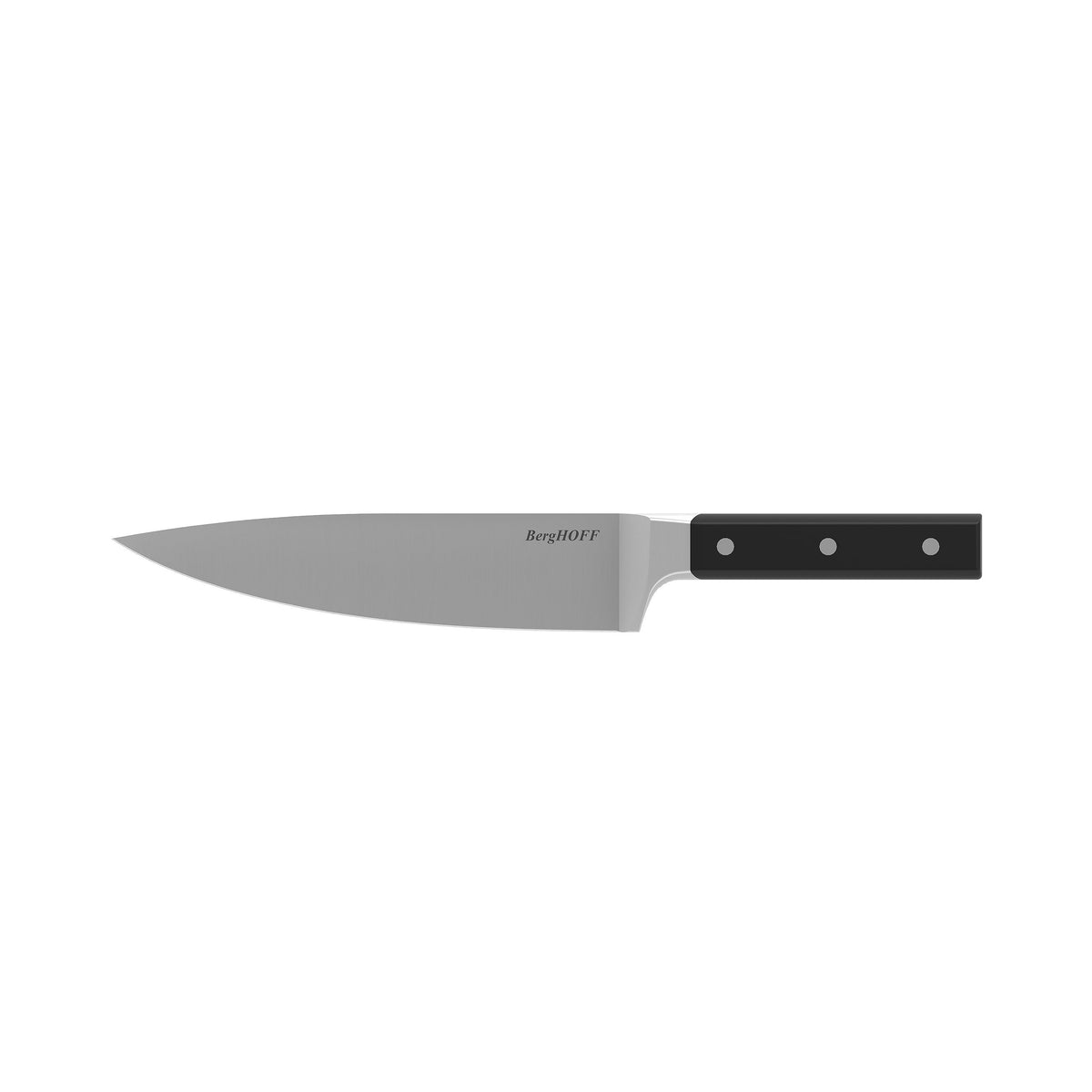
Short answer: most home kitchens need just three knives – a chef's knife (about 20 cm) for most of the work, a small paring knife for peeling and detail, and a serrated bread knife. Add a santoku if you chop a lot of vegetables. Keeping them sharp matters more than owning many: hone often, sharpen when honing no longer helps.
Types of kitchen knives and what they do
| Knife | Blade length | Use it for |
|---|---|---|
| Chef's knife | 18–20 cm | Chopping, slicing, mincing – the everyday workhorse |
| Santoku | 13–18 cm | Vegetables, fish, precise straight slicing |
| Bread knife | 20 cm | Crusty bread, cakes, ripe tomatoes |
| Paring knife | 9–10 cm | Peeling, trimming, small fruit and vegetables |
| Carving knife | 20 cm | Thin slices of roasts, ham and poultry |
Shop by task
If you would rather start from what you cut most often, browse knives for meat and fish for carving and filleting, knives for vegetables and herbs for chopping and fine cuts, and knives for bread and cakes for serrated blades that slice without squashing.
Chef's knife vs santoku
Both are all-rounders. A chef's knife has a curved edge that suits a rocking motion when you chop herbs or onions – for example the forged Gene chef's knife 20 cm with a full tang and three-rivet handle. A santoku has a wider, straighter blade for clean up-and-down cuts and for scooping chopped food off the board; the Graphite santoku 17.5 cm has a scalloped blade that helps slices fall away. Choose the one that feels natural in your hand – you rarely need both.
Forged or stamped?
Forged knives are made from a single piece of steel; they are usually heavier, have a bolster and feel well balanced. Stamped knives are cut from a sheet of steel; they are lighter and usually cheaper. Neither is automatically better – a lighter knife can be faster for quick slicing. What matters is balance, grip and how you keep the edge.
A knife set or individual knives?
Starting from scratch, a knife set is the simplest way to get the core types at once. Count the knives you will actually use, not the pieces in the box: three to five well-chosen knives are worth more than a large block full of specialists. If you already own a good chef's knife, simply add the type you are missing.
Honing vs sharpening
- Honing realigns the fine edge that bends during normal use. Do it often – weekly, or before a big cooking session – with a honing steel such as the Graphite honing steel 22 cm.
- Sharpening removes a little metal to create a new edge. Do it when honing no longer brings the knife back. A simple option for home is the Leo two-stage knife sharpener: the coarse slot reshapes the edge, the fine slot refines it.
Whetstones give the most precise result but take practice. Most European-style kitchen knives are sharpened at roughly 15–20° per side; the key is to keep the angle constant. See all knife sharpeners.
How to keep knives sharp for longer
- Use a wooden or suitable plastic cutting board – never glass, stone or ceramic.
- Wash by hand and dry immediately; the dishwasher dulls edges and damages handles.
- Store knives in a block, on a magnetic strip or with blade guards – not loose in a drawer.
- Don't cut frozen food or bones with an ordinary kitchen knife.
Frequently asked questions
Which kitchen knife should I buy first?
A chef's knife of about 20 cm. It handles most everyday tasks.
What makes a good bread knife?
A long serrated blade (around 20 cm) that cuts through crust without crushing the crumb – like the Gene bread knife 20 cm.
How do I know my knife is dull?
If it slides off the skin of a ripe tomato instead of cutting in, it is time to hone – and if honing doesn't help, to sharpen.
Can kitchen knives go in the dishwasher?
Hand washing is recommended for BergHOFF knives. Heat, moisture and contact with other items wear the edge and handle.