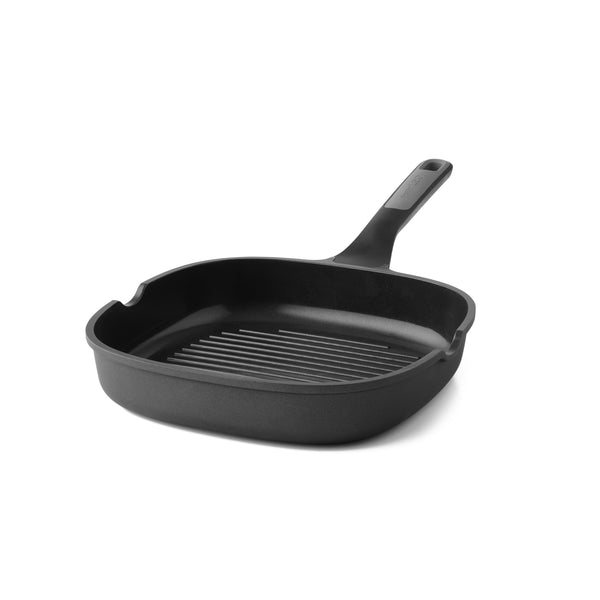
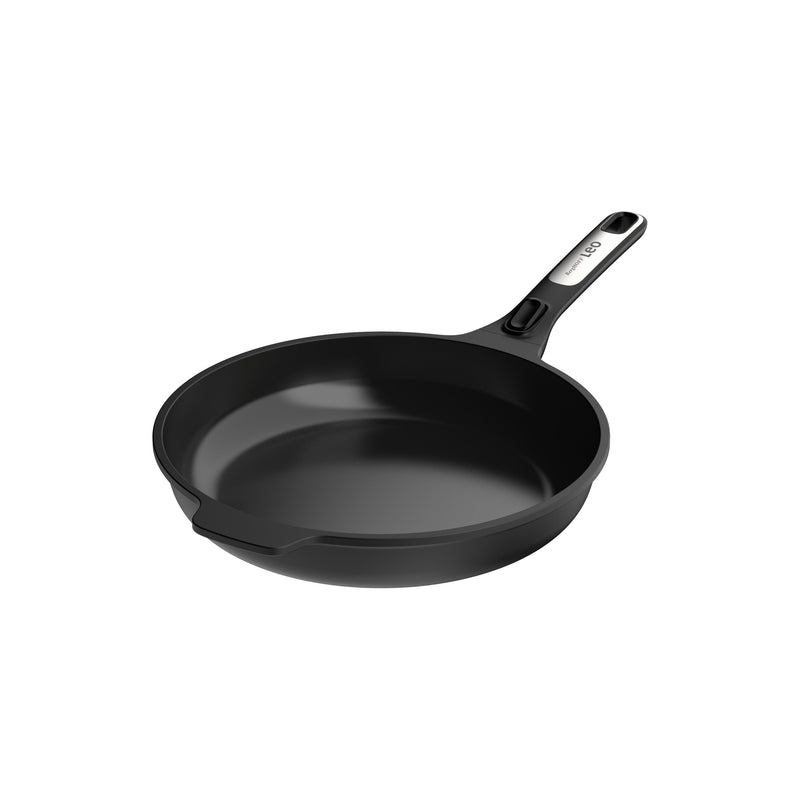
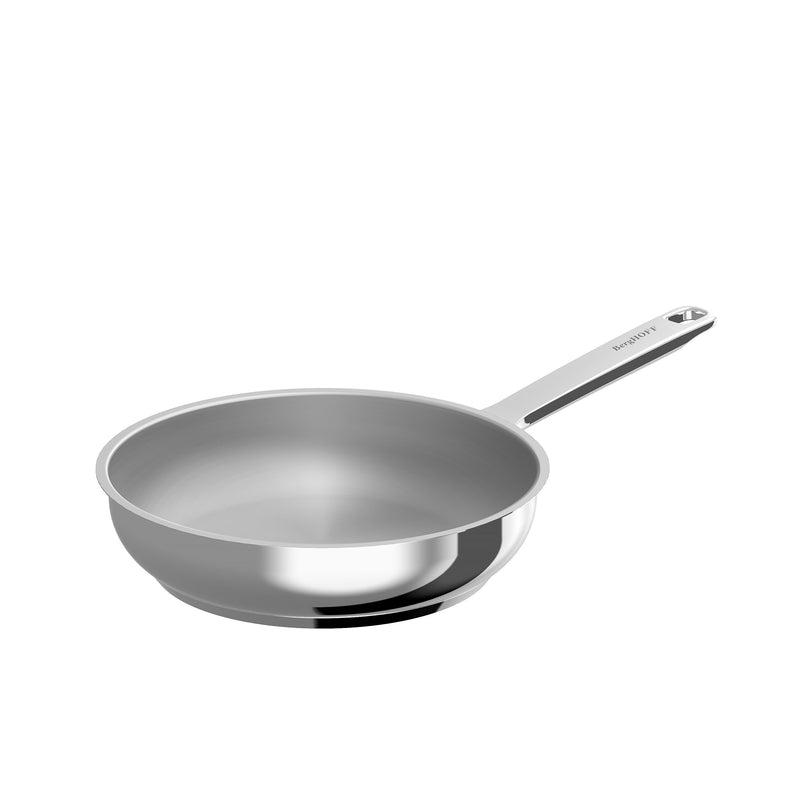
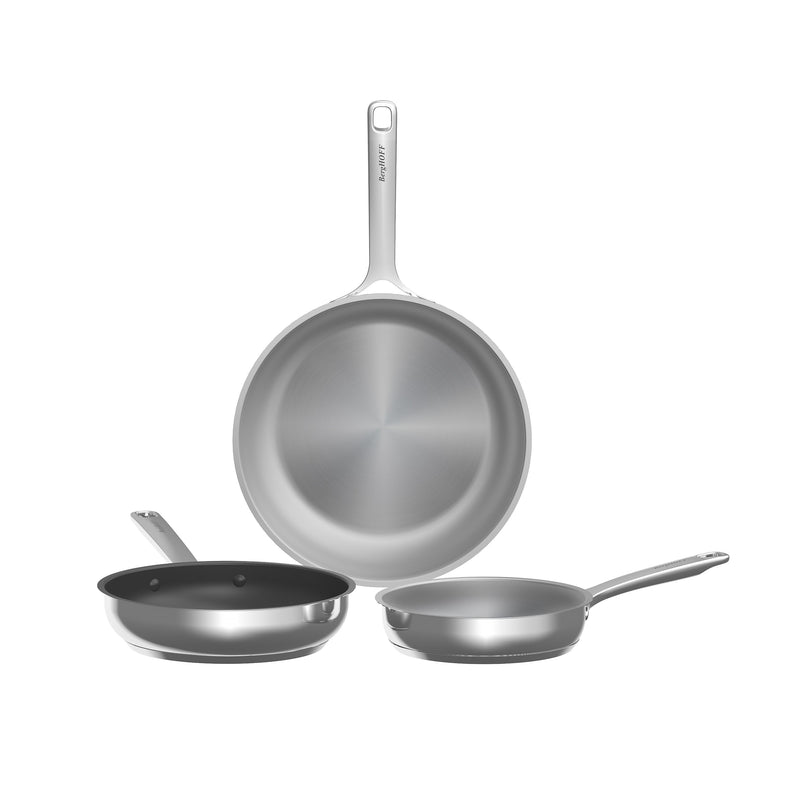
Both coatings do the same job – food slides off and you need very little fat – but they are made from quite different things. PTFE, better known by the trade name Teflon, is a fluorine-based plastic, while a ceramic coating is a hard, mineral-based layer. In day-to-day cooking, the real differences show up in how each one likes to be heated and how it wears over the years. Every non-stick pan and pot in the BergHOFF range has a ceramic CeraGreen coating, which is PFAS-free according to the manufacturer. We don't sell PTFE pans at all.
This guide explains what each coating is, how they compare at the stove, how hot you can take a ceramic pan, how to make the coating last and when it's time to replace it. If you'd rather go straight to the pans, browse our non-stick frying pans. Those pans, and the ceramic-coated pots that go with them, are sold through berghoff.lv and its sister shops berghoff.lt, berghoff.ee, berghoff.fi, berghoff.se and berghoff.dk – the official BergHOFF online stores for the Baltics and the Nordics.
Ceramic vs PTFE at a glance
| Ceramic non-stick | PTFE ('Teflon') non-stick | |
|---|---|---|
| What it is | A hard, mineral-based coating | A smooth fluoropolymer (plastic) coating |
| Surface | Hard and smooth | Smooth and very slippery |
| Best heat | Low to medium, with a short preheat | Low to medium; not meant for very high heat |
| How it wears | Gradually loses its slickness, especially if overheated or left with burnt-on fat | Gradually loses its slickness and can scratch with metal tools |
| Utensils | Wood, silicone or nylon | Wood, silicone or nylon |
| At BergHOFF | Yes – CeraGreen on every non-stick pan and pot | No |
What is a PTFE ('Teflon') coating?
PTFE is short for polytetrafluoroethylene, a plastic made of carbon and fluorine. It is famously slippery, which is how it became the classic non-stick coating. Teflon is simply one brand name for it, but the word has stuck to non-stick pans in general – so you'll often see it used for products that have nothing to do with the brand.
PTFE pans are known for being forgiving with eggs and fish. Like any non-stick surface, though, they aren't built for searing on maximum heat, and the coating wears away with time. When people search for "Teflon pans", they are usually asking something simpler: which non-stick pan should I buy, and how do I look after it? That's what the rest of this guide is about.
What is a ceramic non-stick coating?
A ceramic coating starts as a thin, mineral-based layer that is cured into a hard, glassy surface. A true ceramic coating contains no PTFE. Food lets go easily, the pan wipes clean in seconds, and you can cook with little or no oil.
BergHOFF uses a multi-layer ceramic coating called CeraGreen on all of its non-stick cookware, and the manufacturer states that it is PFAS-free. Underneath is a recycled aluminium body that heats up fast and spreads the heat evenly. That's one reason a ceramic pan rarely needs more than medium heat.
How they compare in the kitchen
Heat
This is where a ceramic pan asks you to change one habit. It works best on low to medium heat after a short preheat. Leave the empty pan on full power and the surface can overheat within a minute – and overheating is what shortens a coating's life. Aluminium conducts heat so well that medium on most hobs is plenty for eggs, pancakes, fish and vegetables.
Food release
Brand new, both types release food beautifully. Later on, the most common reason a ceramic pan starts to stick is a thin film of burnt-on oil, usually left by high heat or spray oil. Clean it gently and regularly, and the surface stays slick for much longer.
Oven use
Most BergHOFF non-stick pans and pots can go in the oven at up to 180 °C. The Graphite and Phantom frying pans handle 230 °C (the Phantom once you've taken off its detachable handle), as do the two-handled Stone+ and Phantom sauté pans and several Stone+ and Phantom pots. The odd one out is the Helix pancake pan 28 cm, which tops out at 150 °C. Check the limit for your own pan and its lid on the product page.
Hobs
Every BergHOFF non-stick pan and pot works on all hobs, induction included. Not sure about the pans you already own? Our guide on how to choose a frying pan shows you how to check.
How to make a ceramic coating last
No non-stick coating lasts for ever, but how you treat the pan makes a big difference. These are the habits that count:
- Never heat the empty pan on full power. Give it a minute or two on medium, then add a little fat and the food.
- Use wooden, silicone or nylon utensils. Metal spatulas and whisks will scratch any coating.
- Skip the spray oil. It tends to leave a sticky film that burns on. A few drops of oil or a knob of butter work better.
- Let it cool before washing. Plunging a hot pan into cold water is hard on both the coating and the body.
- Wash it by hand. All BergHOFF non-stick pans and pots are marked "handwash recommended". Warm water, washing-up liquid and a soft sponge are all you need.
- Stack with care. If your pans live in a pile, put a cloth or a sheet of kitchen paper between them so the base of one doesn't scratch the coating of the next.
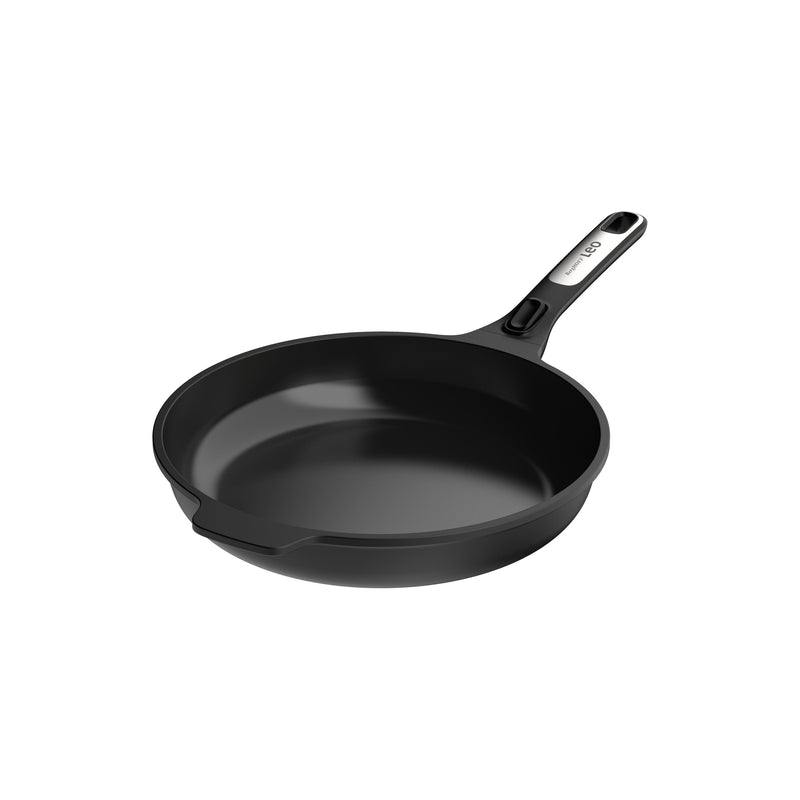
The Dune 28 cm non-stick frying pan (the full Dune range) has a recycled cast aluminium body and a dot base for even heat.
When should you replace a non-stick pan?
There's no set expiry date. It depends on how often you cook, how hot and how you clean. Watch for these signs:
- Eggs and pancakes stick even after a thorough clean and a proper preheat.
- The coating is scratched through, flaking or peeling.
- The base has warped and no longer sits flat on the hob – especially noticeable on induction.
If food sticks but the surface looks fine, try a deep clean first. Simmer a little water in the pan, let it cool, then wash it gently with washing-up liquid and a soft sponge. More often than not, the culprit is a film of old oil rather than a worn-out coating. Once the coating itself is damaged, though, it's time for a new pan.
Non-stick or no coating at all?
For delicate food, non-stick is the easy choice. If you want to sear a steak on high heat, use metal tools or put the pan in the dishwasher, an uncoated pan does the job better. That's why many kitchens have one of each. Find out more in our comparison of stainless steel vs non-stick frying pans, or take a look at our stainless steel frying pans.
What are you cooking?
Choosing a new pan? Start with the food you make most often:
- Pans for eggs and omelettes – this is where a ceramic coating shines, and you barely need any fat.
- Pans for pancakes – low rims and an even surface. Our pancake pan guide walks you through sizes and models, and every one of our pancake and omelette pans has the same ceramic coating.
- Pans for steak – for a proper crust on high heat, an uncoated pan is the better partner.
In our range: Balance Non-stick Omelette Pan 25 cm, Moonmist
Frequently asked questions
Is ceramic better than Teflon?
Neither wins for every cook. Both release food easily, and both need moderate heat and soft utensils. Ceramic coatings are made without PTFE and last longest if you don't overheat the empty pan. All BergHOFF non-stick cookware has a ceramic coating.
Does BergHOFF sell Teflon pans?
No. Every non-stick pan and pot in our range has the ceramic CeraGreen coating, which is PFAS-free according to the manufacturer.
Can I use metal utensils on a ceramic pan?
Better not. Metal can scratch any non-stick coating, while wooden, silicone or nylon utensils keep the surface smooth for longer.
Can a ceramic non-stick pan go in the dishwasher?
BergHOFF recommends washing its non-stick pans and pots by hand. It only takes a moment, because food comes off so easily, and it's gentler on the coating.
Why has my ceramic pan suddenly started to stick?
Usually it's a thin layer of burnt-on oil, or the pan got too hot. Clean it gently, preheat on medium and use a little oil or butter instead of spray. If the coating is scratched through, the pan needs replacing.
Do you have non-stick pots too?
Yes. You'll find saucepans, casseroles and stockpots with the same ceramic coating in our non-stick pots collection.
Where can I buy original BergHOFF ceramic non-stick pans in the Baltics and the Nordics?
BergHOFF's ceramic non-stick pans and pots are sold by berghoff.lv, berghoff.lt, berghoff.ee, berghoff.fi, berghoff.se and berghoff.dk, the official BergHOFF online stores for these countries. Delivery times differ by country: orders to Latvia, Lithuania and Estonia are usually delivered within 1–2 business days, and orders to Finland, Sweden and Denmark within 2–3 business days. Delivery is free for orders of €59 or more (or the equivalent amount in your currency), and as a consumer you can withdraw from your purchase within 14 days without giving a reason.